

September 1, 2026
How planned 7–8% losses protect portfolios and advisor-client trust.
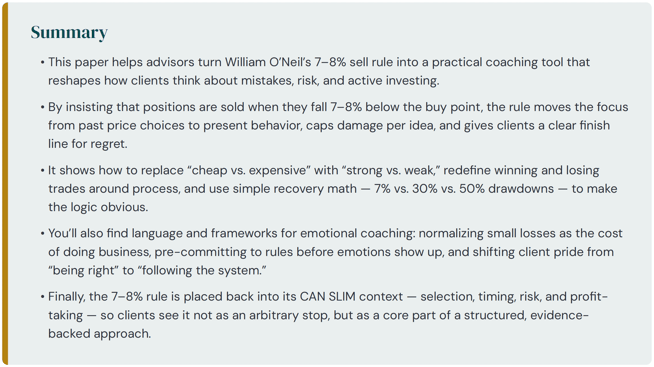
Financial advisors can use William O’Neil’s 7–8% sell rule to move clients away from the vague slogan “buy low, sell high” toward a clear, behavior-focused discipline: a “mistake” is not buying at the wrong price, it is refusing to cut a small loss before it becomes portfolio damage.
Why “Buy Low, Sell High” Misleads Active Investors
You already know the phrase. It sounds wise. It is also almost useless for real-world, active investing. Traditional “buy low, sell high” carries a few hidden problems for clients who trade individual stocks:
- It suggests that low price equals opportunity. O’Neil’s research across more than 100 years of market winners shows the opposite. The biggest winners were bought near new highs, not at depressed “bargain” levels.
- It has no built-in risk control. If you buy something “low” and it keeps falling, the old slogan gives you no clear exit. That gap is where many portfolios quietly bleed.
-
It sounds like a one-time timing trick, not a repeatable process. Clients hear it and think success is about guessing turning points rather than following rules.
O’Neil’s work reframes the game. His CAN SLIM system focuses on strong earnings growth, price strength, institutional sponsorship, and proper market direction. The real edge is not finding “cheap” stocks. It is buying strength and cutting weakness quickly. For financial advisors, the key is this: clients don’t need another clever phrase. They need a definition of “mistake” that is specific, measurable, and executable.
The 7–8% Rule: A New Definition of “Mistake”
O’Neil’s central risk rule is brutally simple: if a stock falls 7–8% below your purchase price, you sell. No exceptions. No hoping. No waiting to “see what happens.” That rule does three important things for an advisor-client relationship:
-
It moves “mistake” from the past (the entry price) to the present behavior. The mistake is not buying slightly too high. The mistake is holding a stock as it drifts into deeper loss.
-
It caps damage per position. A 7–8% stop-loss keeps any single idea from turning into a portfolio-level crisis, especially in concentrated or growth-focused strategies. O’Neil stresses that cutting small losses is the difference between long-term success and disaster.
-
It gives clients a finish line for regret. When the rule is clear, there is no torturing “What if I’d just waited?” You agreed to exit at 7–8%. You followed the rule. The process, not the outcome, becomes the yardstick.
O’Neil even calls small losses “the cost of doing business.” The stop-loss is not evidence of failure. It is a routine operating expense in active investing. For advisors, that’s a powerful reframing tool. You can say:

From Price Mythology to Process: How Advisors Can Reframe
Clients come in with decades of “buy low, sell high” baked into their thinking. You can’t just tell them they’re wrong. You have to give them a cleaner story. Here is a practical shift you can walk them through.
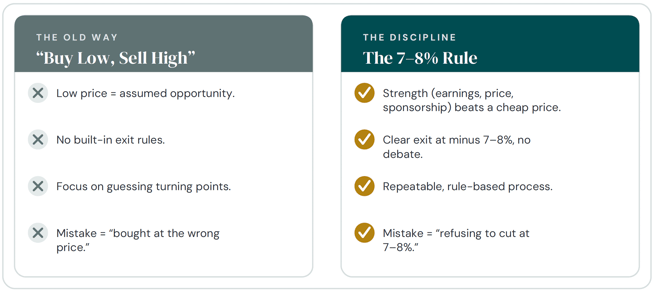
EXHIBIT 1 From price mythology to process discipline. The reframe advisors can put in front of clients: strength over cheapness, a defined exit, and a new definition of “mistake.”
1. Replace “cheap vs. expensive” with “strong vs. weak”
O’Neil shows that the best performers had explosive earnings and sales, were leaders in their industries, and traded near highs with strong relative strength.
-
We don’t hunt for low prices. We hunt for strong businesses with strong price action.”
- “Buying near a high is not ‘late’ if the fundamentals and demand are surging. It is aligned with what big institutional buyers are doing.”
This moves the conversation away from sticker shock. Clients stop asking, “Why are we buying this stock at a high?” and start asking, “Does it meet the strength criteria?”
2. Redefine winning and losing trades
In most clients’ minds:
-
Winner = made money
-
Loser = lost money
That mental model is brutal for active strategies. It ignores process altogether. Using O’Neil’s framework, advisors can redefine:
-
Good trade: Followed the system, respected the 7–8% rule, aligned with CAN SLIM-style criteria, regardless of outcome.
-
Bad trade: Violated the exit rule, averaged down into weakness, or bought based on “cheap” valuations without strong earnings or demand.
This lets you say, very plainly, “A losing trade can be a good trade if you followed the discipline. A profitable trade can be bad if it broke every rule and simply got lucky.”
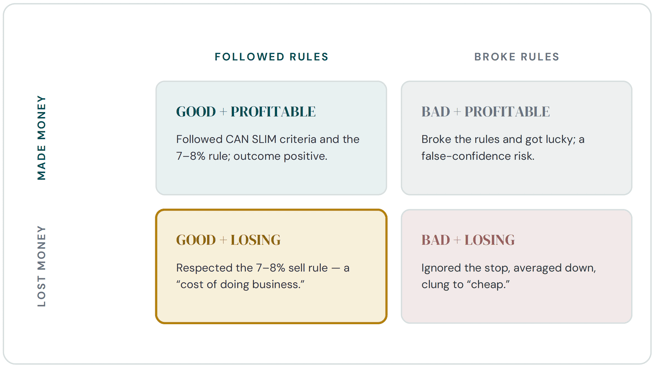
EXHIBIT 2 Good vs. bad is defined by process, not P&L. A losing trade can be a good trade when the discipline is followed; a winning trade can be a bad one when the rules are broken.
That distinction matters for coaching. Clients start to see “mistakes” as rule-breaking, not red numbers.
3. Use math to show why small losses are non-negotiable
O’Neil warns that large losses are toxic because the required recovery rate explodes. A 50% loss needs a 100% gain to get back to even. The 7–8% rule keeps you far away from that zone. Advisors can walk through simple numbers:
-
Lose 7%, you need roughly 7.5% to get back.
-
Lose 30%, you now need about 43% to recover.
-
Lose 50%, you need 100%.
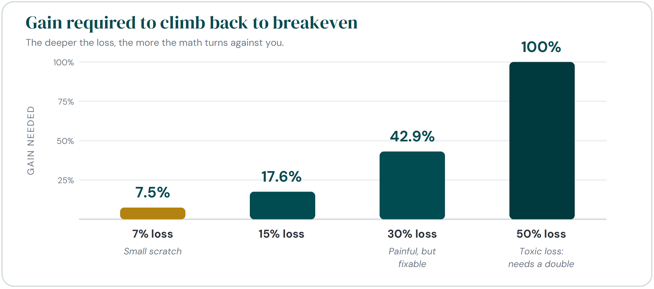
EXHIBIT 3 Why small losses matter: the recovery math. Gain required to return to breakeven after a given loss. Figures are the paper’s cited recovery rates (≈7.5%, 17.6%, 42.9%, 100%).
Clients usually understand this quickly. You can connect it straight to the rule:
“Every time we ignore the 7–8% stop, we are voluntarily signing up for much harder math.”
Again, the “mistake” is not buying at the wrong level. It is choosing harder math than you need.
Emotional Coaching: Making the Rule Livable
O’Neil’s central risk rule is brutally simple: if a stock falls 7–8% below your purchase price, you sell. No exceptions. No hoping. No waiti
The hardest part is not the math. It is the psychology.
O’Neil points out that investing success is largely emotional discipline. People cling to losers, panic out of winners, and lean on stories instead of rules.
Advisors can use the 7–8% rule as an anchor for emotional coaching.
Normalize small losses as routine, not failure
Say it out loud to clients:
-
“In this strategy, we expect a series of small losses.”
-
“If we are cutting a stock at minus 7–8%, that tells us the system is working, not broken.”
You can even quantify the expectation using O’Neil’s research tone: active growth systems are built on many small scratches and a minority of strong winners that drive most of the return.
Clients stop treating each stopped-out trade as a crisis and start seeing the portfolio as a whole.
Pre-commit to rules before emotions show up
O’Neil insists that rules must be set before the trade is placed. Once money is in motion, emotions take over. Advisors can formalize:
-
Every new position gets a documented entry rationale, plus a stop at 7–8% below purchase.
-
The client signs off on that structure.
-
When the stop hits, the action is automatic. There is no debate at minus 6% or minus 7%.
When clients know this is coming, they experience the exit as “We’re following the plan we agreed on,” not “My advisor is giving up on the stock.”
Shift pride from “being right” to “following the system”
Many clients measure their self-worth by how often they “called it.” O’Neil encourages the opposite mindset: the market punishes ego but rewards systematic discipline.
Advisors can reframe pride:
-
“Your success is not how often you guess the top or bottom. It is how reliably you follow the 7–8% risk rule and our selection criteria.”
You are inviting them to take pride in behavior, not prediction.
Practical Talking Points Advisors Can Use
Here are some ready-made lines you can adapt in client conversations, all rooted in O’Neil’s principles.
-
“We don’t ‘buy low’ in the old sense. We buy strong companies showing strong demand. Then we manage risk with a strict 7–8% exit rule.”
-
“A mistake in this portfolio is not taking a loss. A mistake is refusing to take the agreed-upon loss at 7–8%and letting it grow.”
-
“Every position comes with two numbers: a buy point and a maximum loss. The buy point reflects strength. The loss limit protects the whole plan.”
-
“Small, frequent scratches are built into this strategy. They are a cost of doing business in active growth investing, not a sign that something is broken.”
-
“If a stock hits our 7–8% loss limit, we exit. If it rises 20–25%, we evaluate whether it is a short-term gain to lock in or a longer-term leader to hold. The important thing is that we decide using rules, not headlines.”
The more often clients hear this language, the faster they internalize it.
Integrating the 7–8% Rule Inside a Broader Advisory Framework
Of course, you’re not building portfolios on stop-loss rules alone. O’Neil’s book wraps the 7–8% guideline inside a bigger structure: CAN SLIM, chart patterns, market direction, and position sizing.
Advisors can use that context to keep the message coherent:
-
Selection: Favor companies with strong current and annual earnings, something truly new, leadership in their group, and clear institutional sponsorship, all in a rising market.
-
Timing: Enter near proper breakouts, not random dips, using basic chart patterns like cup-with-handle, flat bases, and high-volume moves.
-
Risk: Apply the 7–8% sell rule on every position. Avoid averaging down. Only add to winners, not losers.
-
Profit-taking: Consider selling partial or full positions after 20–25% gains unless the stock displays exceptional strength indicating potential for extended moves.
When clients see the 7–8% rule as one piece inside that broader method, they understand the logic. It is not an arbitrary stop. It is wired to a full, evidence-backed process.
You can summarize it for them like this:

That kind of narrative makes active investing feel structured rather than random.
Why This Reframing Matters for Advisor-Client Trust
At the end of the day, this is about trust and expectations.
If you leave clients with “buy low, sell high,” they will judge you by whether each trade looks cheap or ends in profit. That is a harsh, binary world. It punishes any strategy that uses controlled losses as part of its engine.
By reframing around the 7–8% rule:
-
You define success as consistent rule-following across the portfolio.
-
You set shared expectations that losses will happen, but they will be contained.
-
You reduce emotional blow-ups when a position is stopped out, because the client sees it as proof that the discipline is alive.
O’Neil’s research has influenced generations of investors precisely because it treats risk control as central, not as a side note. His stop-loss rule is a practical bridge between academic risk talk and day-to-day decisions.
Financial advisors can borrow that bridge. Instead of repeating a vague slogan from a different market era, you can give clients a concrete rule that redefines what “mistake” means in active investing.
You move them from “I don’t want to be wrong” to “I want to be consistent.”
That shift, frankly, is where long-term results and calmer client relationships tend to show up.
DISCLOSURES
Carefully consider the Fund’s investment objectives, risks, charges, and expenses before investing. This and other information can be found in the Fund’s statutory and summary prospectuses, which may be obtained at CapForceETF.com. Read the prospectus carefully before investing.
Investing involves risks. Principal loss is possible. The Fund's return may not match the return of the Index. Along with general market risks, an ETF that concentrates its investments in the securities of a particular industry, market, sector, or geographic area may be more volatile than a fund that invests in a broader range of industries. Additionally, the Fund may invest in securities that have additional risks. Foreign companies can be more volatile, less liquid, and subject to the risk of currency fluctuations. This risk is greater for emerging markets. Small- and mid-cap companies can have limited liquidity and greater volatility than large-cap companies. Also, ETFs face numerous market trading risks, including the potential lack of an active market for Fund shares, losses from trading in secondary markets, periods of high volatility and disruption in the creation/ redemption process of the Fund.
The IBD® Breakout Stocks Index is the fund’s underlying index and is a proprietary index calculated by Investor’s Business Daily® that seeks to identify stock breakout opportunities, or stocks poised to experience a period of sustained price growth beyond the security's recent "resistance level", with consideration for various market conditions.
The "IBD®" mark and logo have been licensed to the Adviser by Investor’s Business Daily,® ("IBD") for use in connection with the Fund under certain circumstances. The Fund is not sponsored, endorsed or sold by IBD. IBD makes no representation regarding the advisability of investing in the Fund. The Investor's Business Daily mark and associated logos are used with permission by IBD.
Neither CapForce ETF, Foreside nor Investor's Business Daily® are related.
CapForce ETFs are distributed by Foreside Fund Services, LLC.

Dynamic Selection – Active Minds In An ETF Wrapper
Understanding Active Share