

September 17, 2026
How IRCD Turns Advisors Into Rules-Driven Portfolio Architects
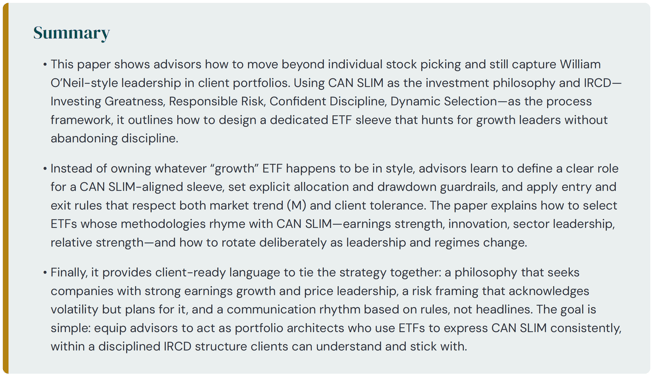
Implementing CAN SLIM through ETFs means your “edge” lives in how you select, combine, and manage ETFs that systematically capture O’Neil-style leadership, while your IRCD framework governs the risk, discipline, and communication around those choices.
What CAN SLIM in an ETF Context Really Means
In O’Neil’s world, CAN SLIM was expressed through individual stocks—strong earnings, innovation, leadership, sponsorship, and alignment with the market trend. In an ETF-based practice, you are doing something analogous at the fund level: choosing vehicles that embed those traits in their underlying baskets or that give you a flexible shell for dynamic growth exposure.
There are two main paths:
-
Use explicitly CAN SLIM-linked products (for example, IBD-based indexes or strategies that rank stocks using the seven CAN SLIM factors).
-
Use high-growth, quality, and thematic ETFs whose selection rules rhyme with CAN SLIM (earnings growth, quality screens, leadership in top industries), then layer your own timing and risk rules on top.
In both cases, the ETF is just the wrapper. Your IRCD-aligned process—how you define winners, size positions, cut risk, and explain it to clients—is still the heart of the strategy.
Designing an IRCD-Aligned CAN SLIM ETF Sleeve
Investing Greatness: codifying the equity role
First, clarify where this CAN SLIM ETF sleeve sits in your overall lineup. In most advisory practices, it will be a growth-tilted satellite around a more diversified, possibly factor-neutral core. That fits O’Neil’s reality: this is an alpha-seeking, leadership-hunting discipline, not a full household allocation by itself.
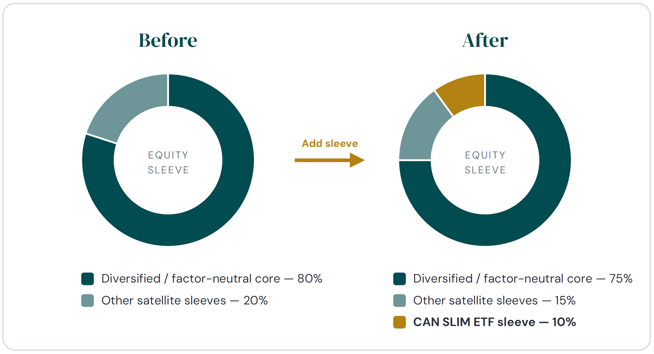
EXHIBIT 1 The CAN SLIM sleeve as a satellite, not the core. Sizing a leadership sleeve as a growth-tilted satellite around a diversified core. Allocations are illustrative.
You can define Investing Greatness in ETF form as:
- A deliberately narrow, growth-oriented allocation whose mandate is to own leadership (not merely
“growth style” generically). -
A rules-based selection process that favors funds tracking CAN SLIM screens (like IBD-ranked indexes) or using similar earnings and leadership filters.
-
A written philosophy statement that says, in plain language, “This sleeve seeks companies exhibiting strong earnings growth, innovation, and price leadership, primarily through ETFs whose methodologies reflect CAN SLIM-style criteria.”
This lets you explain to clients that you’re not chasing fads; you’re outsourcing part of the stock picking to data-driven ETFs while retaining control of higher-level portfolio design and risk.
Responsible Risk: risk design before product choice
With ETFs, risk design happens at several levels:
-
Allocation size: Decide what percentage of equity or total portfolio this CAN SLIM-aligned sleeve will occupy in a typical client plan (for example, 10–30% of equities, depending on risk tolerance).
-
Volatility and concentration: CAN SLIM-style portfolios often tilt toward volatile, high-growth names. ETF versions may be concentrated (e.g., 50–100 stocks) or more diversified; your job is to choose structures whose volatility fits your client base and to size them appropriately.
-
Drawdown expectations: Use backtests or history of IBD-based and growth ETFs to estimate typical drawdowns, and bake those into client education and IPS language.
O’Neil’s spirit of the 7–8% rule still applies, but now at position and sleeve levels rather than single stocks. For example, you might:
-
Cap any single CAN SLIM-aligned ETF at a modest percentage of the total portfolio, so no one fund can derail the client experience.
-
Set portfolio-level rules: if the sleeve falls more than a predetermined threshold (say 15–20%), you automatically review exposure against your M (market trend) readings and either reduce risk or stand firm according to pre-agreed criteria.
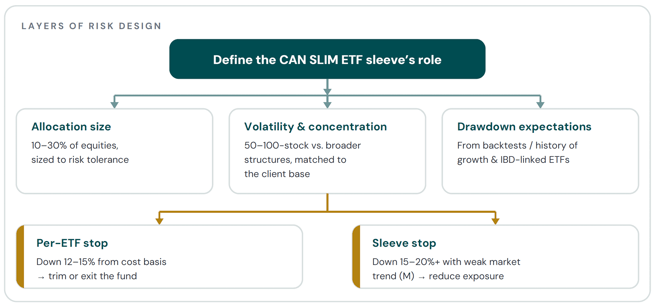
EXHIBIT 2 Translating the 7–8% rule into ETF and sleeve stops. Risk is designed in layers — allocation, structure and drawdown — before any product is chosen. Ranges are illustrative and drawn from the ranges cited in this paper.
This translates CapitalFORCE’s belief that “realized risk is opportunity if it is planned” into ETF language clients can live with.

Confident Discipline: rules for entries, exits, and M
The biggest challenge with an ETF CAN SLIM sleeve is not finding products; it’s consistently applying a timing and risk discipline on top of them.
Entry rules with ETFs
Instead of buying a single stock on a breakout from a base, you can:
-
Enter CAN SLIM-linked or high-growth factor ETFs when broad CAN SLIM market indicators turn positive—rally follow-through days, major indexes reclaiming moving averages, or internal breadth expanding.
- Scale in over several tranches as confirmation builds, acknowledging that with ETFs you are buying baskets where leadership is emerging at the aggregate level.
This keeps you aligned with M (market direction) and helps avoid loading up on growth exposure into obvious downtrends.
Exit and risk rules with ETFs
Since you cannot use a strict 7–8% stop on each underlying stock, you can adapt the logic:
-
Define a maximum drawdown per ETF from your cost basis—say 12–15%—beyond which you either trim or fully exit that fund.
-
Use technical triggers on the ETF itself (break of the 50- or 200-day moving average on volume, relative strength versus a broad benchmark rolling over) as systematic exit signals.
-
Incorporate fundamental drift: if an ETF’s methodology changes or its underlying screen no longer looks CAN SLIM-like (weakening earnings criteria, less emphasis on leadership), you replace it.
At the sleeve level, you can also set a “portfolio stop”: if the CAN SLIM ETF sleeve drops, for example, 20–25%from its high and the broad market is in a confirmed downtrend, you reduce exposure materially until conditions improve.
These are the ETF analogs of O’Neil’s insistence on cutting losers fast and respecting bear markets—and they’re much easier to explain in a review meeting when they were pre-committed rather than improvised.
Dynamic Selection: choosing and rotating ETFs
Dynamic Selection in an ETF world means you continuously scan the investable universe for funds that best express CAN SLIM principles in the current regime and rotate deliberately as leadership changes.
A practical process for advisors might include:
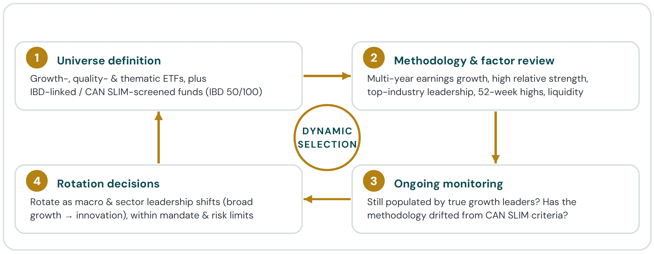
EXHIBIT 3 Dynamic Selection is a loop, not a set-and-forget list. A continuous cycle of defining the universe, reviewing methodology, monitoring leadership and rotating deliberately as regimes change.
Universe definition
-
Start with growth-tilted, quality-tilted, and thematic ETFs that emphasize earnings growth, innovation, and sector leadership.
- Include any IBD-linked or similar ETFs that explicitly reference CAN SLIM screens or IBD 50/100 indexes.
Methodology and factor review
-
Evaluate each ETF’s index or strategy rules: Do they require multi-year earnings growth, high relative strength, or leadership in top-ranked industries?
- Prefer funds whose construction looks closest to a systematic CAN SLIM screen (e.g., high EPS growth, proximity to 52-week highs, minimum institutional ownership, float and liquidity constraints).
Ongoing monitoring and rotation
-
Regularly review performance and composition: Is the ETF still populated by true growth leaders, or has it drifted toward lower-quality names?
-
Rotate between ETFs as macro and sector leadership changes—for example, from broad growth leadership to more focused innovation themes—while staying within your risk and mandate constraints.
This is where your ETF-level CAN SLIM process directly reflects Dynamic Selection in the IRCD framework: you avoid static, “check-the-box” growth exposure and instead treat the ETF lineup as a living expression of your best CAN SLIM-style opportunities at each point in the cycle.
Communicating the Strategy to Clients
For advisors, success is not just in returns but in how well clients understand and stick with the process. The CAN SLIM-plus-IRCD narrative lends itself to clear explanations:
-
Philosophy: “This sleeve owns companies with strong earnings growth, innovation, and price leadership, primarily through ETFs that systematically screen for those traits.”
-
Risk framing: “Because these are leadership-seeking funds, they can be more volatile. We limit them to a specific portfolio slice, use predefined risk controls, and step back when the overall market is in a confirmed downtrend.”
-
Process updates: “We will communicate changes when our rules trigger them—when we add or remove ETFs based on methodology, leadership, or risk—not based on short-term headlines.”
DISCLOSURES
Carefully consider the Fund’s investment objectives, risks, charges, and expenses before investing. This and other information can be found in the Fund’s statutory and summary prospectuses, which may be obtained at CapForceETF.com. Read the prospectus carefully before investing.
Investing involves risks. Principal loss is possible. The Fund's return may not match the return of the Index. Along with general market risks, an ETF that concentrates its investments in the securities of a particular industry, market, sector, or geographic area may be more volatile than a fund that invests in a broader range of industries. Additionally, the Fund may invest in securities that have additional risks. Foreign companies can be more volatile, less liquid, and subject to the risk of currency fluctuations. This risk is greater for emerging markets. Small- and mid-cap companies can have limited liquidity and greater volatility than large-cap companies. Also, ETFs face numerous market trading risks, including the potential lack of an active market for Fund shares, losses from trading in secondary markets, periods of high volatility and disruption in the creation/ redemption process of the Fund.
The IBD® Breakout Stocks Index is the fund’s underlying index and is a proprietary index calculated by Investor’s Business Daily® that seeks to identify stock breakout opportunities, or stocks poised to experience a period of sustained price growth beyond the security's recent "resistance level", with consideration for various market conditions.
The "IBD®" mark and logo have been licensed to the Adviser by Investor’s Business Daily,® ("IBD") for use in connection with the Fund under certain circumstances. The Fund is not sponsored, endorsed or sold by IBD. IBD makes no representation regarding the advisability of investing in the Fund. The Investor's Business Daily mark and associated logos are used with permission by IBD.
Neither CapForce ETF, Foreside nor Investor's Business Daily® are related.
CapForce ETFs are distributed by Foreside Fund Services, LLC.
